


Alpine Trails And Rallies - Mountain Motor Sport 1910-1973
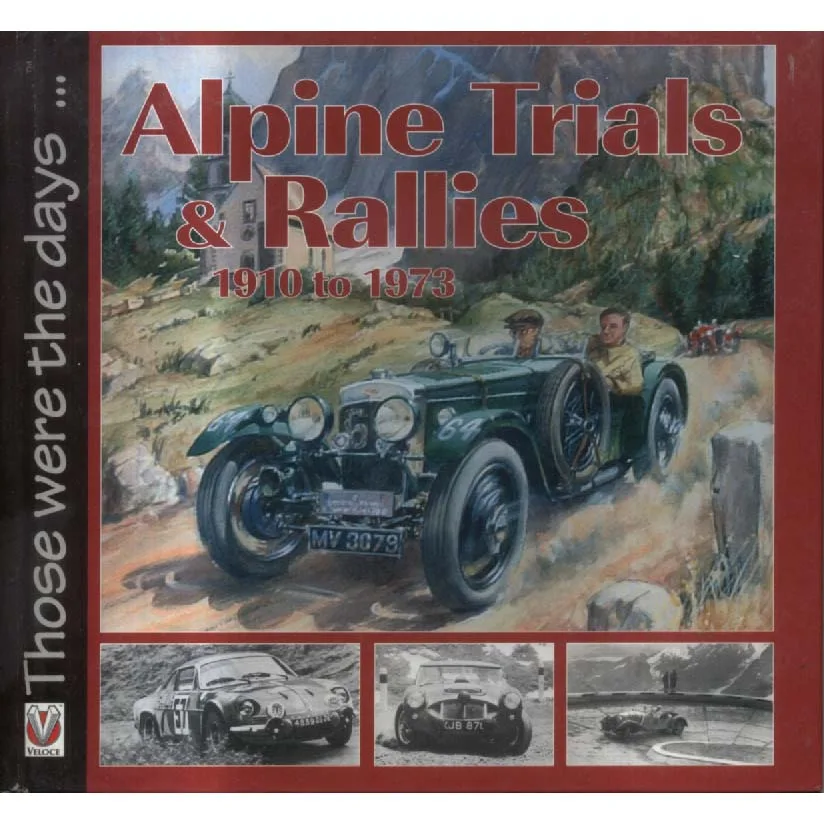
Publisher: Veloce Publishing
Format: Hardback
ISBN: 9781904788959
There are perfectly sensible places to organise motor races: purpose-built circuits, wide open roads and locations conveniently equipped with grandstands, refreshment facilities and reasonably level ground. Then there are the Alps, where early motoring enthusiasts decided that the ideal way to test a motor car was to drive it up a mountain, around several hundred hairpin bends and down the other side, preferably without the brakes catching fire or the engine surrendering somewhere above the snowline.
In Alpine Trails and Rallies – Mountain Motor Sport 1910–1973 (2005), Martin Pfundner explores the extraordinary history of competitive motoring in Europe’s magnificent mountain ranges. Published by Veloce Publishing, this fascinating historical account celebrates an era when motorsport demanded not merely speed and driving ability, but endurance, mechanical ingenuity and a thoroughly unreasonable degree of optimism.
Beginning in the pioneering years before the First World War, Alpine motoring competitions presented extraordinary challenges to both cars and their occupants. Roads were frequently narrow, steep and unpredictable, while engines possessed modest power and cooling systems sometimes regarded prolonged climbing as a personal insult. Drivers faced formidable gradients, unpredictable weather and the constant possibility of discovering that their brakes were considerably more enthusiastic about accelerating than stopping.
Yet these demanding events became important proving grounds for the emerging motor industry. Manufacturers recognised that surviving an Alpine trial provided convincing evidence of a vehicle’s reliability, handling and mechanical strength. A car capable of conquering mountain passes under competitive conditions could reasonably be expected to manage the journey to the local railway station, assuming its owner possessed sufficient confidence.
Pfundner traces the development of Alpine trials and rallies through decades of changing automotive technology, competition regulations and sporting ambition. The story encompasses the achievements of manufacturers, determined competitors and the remarkable machines that tackled some of Europe’s most spectacular and unforgiving roads.
The period covered, from 1910 to 1973, witnessed an extraordinary transformation in motorsport. Early competitors struggled with primitive machinery and rudimentary roads, while later generations enjoyed increasingly sophisticated vehicles capable of negotiating mountain routes at speeds that would have horrified their predecessors, not to mention the unfortunate livestock living beside the road.
There is something wonderfully heroic about this particular form of competition. Unlike circuit racing, where a mechanical failure might involve a short walk back to the paddock, an Alpine breakdown could leave competitors contemplating their mechanical shortcomings in the company of glaciers, pine trees and distant cowbells.
Condition: Good. This is a previously owned copy dating from 2005, displaying ordinary signs of age and handling. Unlike the competition vehicles described within, it has survived without requiring replacement brake linings, extensive engine repairs or recovery from an inconveniently situated mountain pass.
Published by Veloce Publishing in 2005. ISBN: 9781904788959.
Offered by Crappy Old Books, where we admire the remarkable courage of early motorists, particularly their willingness to tackle enormous mountains in vehicles that occasionally struggled to climb an ordinary hill.
An excellent addition to any collection of historic motorsport, rallying history or classic automotive competition. Particularly recommended for enthusiasts who appreciate that the golden age of motoring involved more than driving quickly: it also required the ability to repair a carburettor at altitude while wondering whether the next bend might be the last.
Keep browsing: See more Transport books Other books by Martin Pfundner
